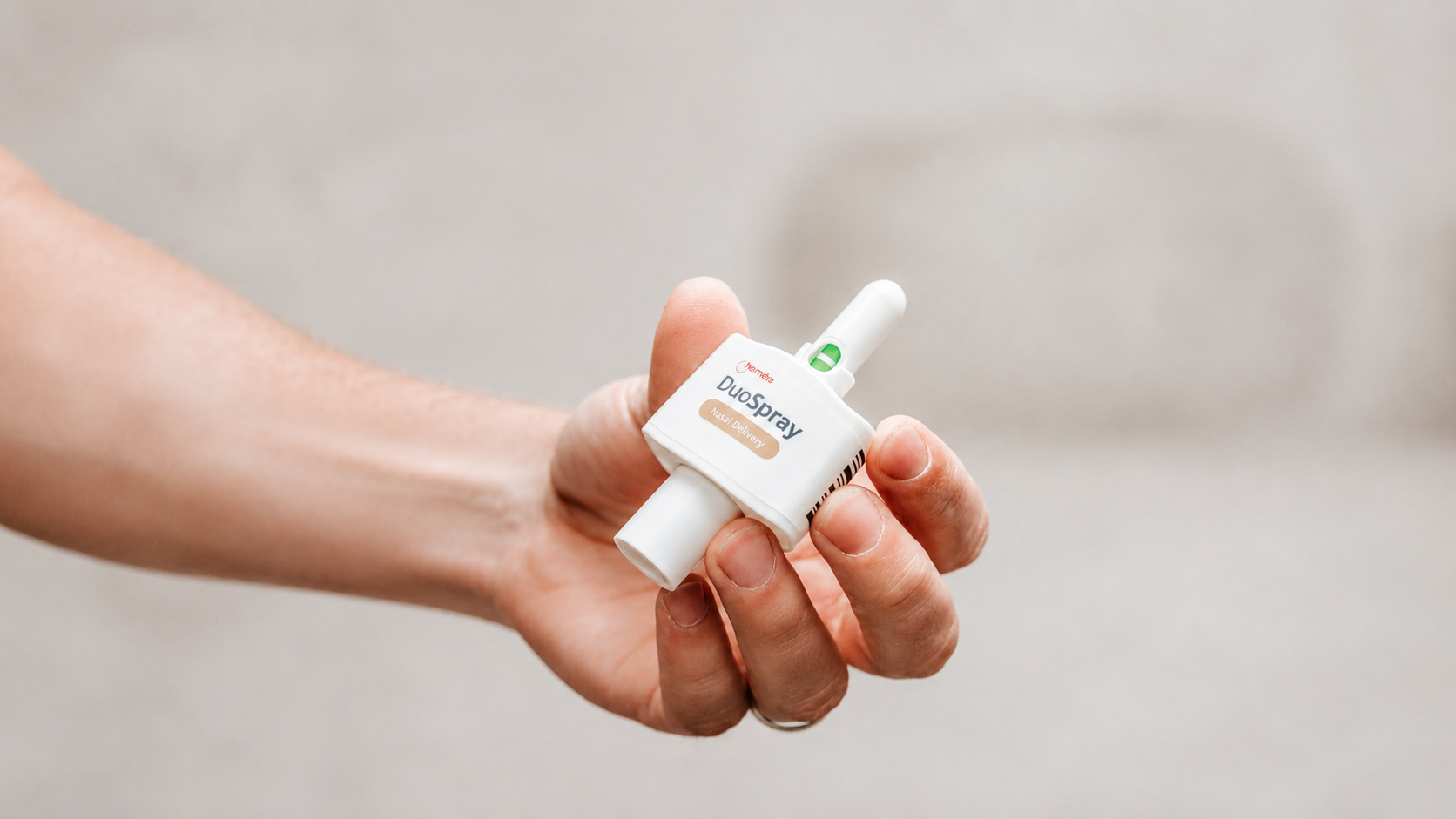
NOSE-TO-BRAIN DELIVERY: PATIENT-CENTRIC DEVICE DEVELOPMENT AND PERFORMANCE TESTING
Published: 24/04/2025
Sophie Conte and Alain Regard describe Nemera’s journey in nose-to-brain device development, highlighting the evaluation tools, methods and usability testing developed in-house to steer innovative device design and engineering.
The nose has been used as a portal to deliver therapeutic substances for thousands of years. In Amazonian cultures, simple handmade tools are used to administer pharmacologically active “rapeh” powders to the nose for ceremonial and medicinal purposes. In contemporary medicine, the intranasal devices used to deliver synthetic therapeutic compounds are technologically intricate. Nonetheless, achieving consistent and effective nose-to-brain (N2B) drug delivery remains a complex challenge.
MULTI-DIMENSIONAL CHALLENGES IN N2B DRUG DELIVERY
Nasal drug delivery is a promising route for direct brain targeting, especially in central nervous system (CNS) disorders and neurodegenerative diseases, such as Parkinson’s and Alzheimer’s diseases, as well as some brain cancers. Drug development pipelines include small molecules, proteins, peptides and nucleic acid-based candidates. Today, achieving clinically effective N2B drug delivery is close to becoming a reality thanks to the multidisciplinary approach integrating pharmaceutics, pharmacology and ergonomic device engineering to overcome numerous challenges.
Formulation Challenges
Formulation-based drug delivery technologies, such as functional excipients, complex formulation and processing technologies, feature in the multifaceted approach in systemic and direct-to-brain nasal delivery. Formulations are designed to protect the API (e.g. encapsulation); increase residence time (e.g. muco-adhesive and thermogelling excipients); and enhance permeation, absorption and uptake into transport systems and tissues (e.g. solubilisers and permeability enhancers).
Formulation viscosity has a significant impact on deliverability to a precise target in the nasal cavity and on device performance. Ideally, an N2B delivery device must achieve consistent performance across a range of viscosities.
Anatomical and Physiological Challenges CNS and direct-to-brain drug delivery via the nose has gained significant interest and traction due to the identification and greater understanding of three different transport pathways:
- The Olfactory Mucosal Pathway: The olfactory cleft epithelium is unciliated and associated with reduced drug clearance and increased residence time. Absorption occurs through paracellular junctions leading to uptake into cerebrospinal fluid and transport to the brain, bypassing the blood–brain barrier (BBB). This pathway is purported to result in faster onset of clinical effects.
- The Trigeminal Nerve Pathway: The epithelium in this area is a major drug deposition target site for systemic drug delivery. It is highly innervated with trigeminal nerves, and may also be a minor pathway for CNS and brain delivery for drug compounds unable to pass the BBB.
- The Olfactory Nerve Pathway: The olfactory nerves in the upper nasal cavity provide a localised target for drug delivery; as these nerves transmit sensory information related to smell from the nasal cavity to the brain, it is proposed that this may constitute another gateway to CNS uptake and brain delivery.
For direct N2B delivery, the olfactory mucosal pathway is considered the most promising. However, achieving precise drug deposition in this small, inaccessible area – high-up, towards the back of the nasal cavity and approximately 7 cm from the nostrils – requires the design of a device with specific performance features with respect to plume characteristics, velocity and trajectory.
Usability Challenges in Intranasal Device Design
Usability and human factors engineering (HFE) studies are crucial for developing user-friendly and safe devices that foster patient adherence and acceptability. Devices that are uncomfortable, difficult to use or intimidating are less likely to be used correctly and consistently. These studies engage patients, caregivers and healthcare professionals to identify key design factors, such as comfort (minimise discomfort during insertion and dose expulsion), ease of use (intuitive design that simplifies administration and addresses dexterity issues) and safety of use (clear, concise instructions and training materials to ensure proper use).
To read the full article: https://www.nemera.net/wp-content/uploads/2025/04/Pulmonary_Nasal_Nemera.pdf